
Home Building Guide
Rainwater Harvesting for Bangalore Homes: System Options, Costs and Approvals
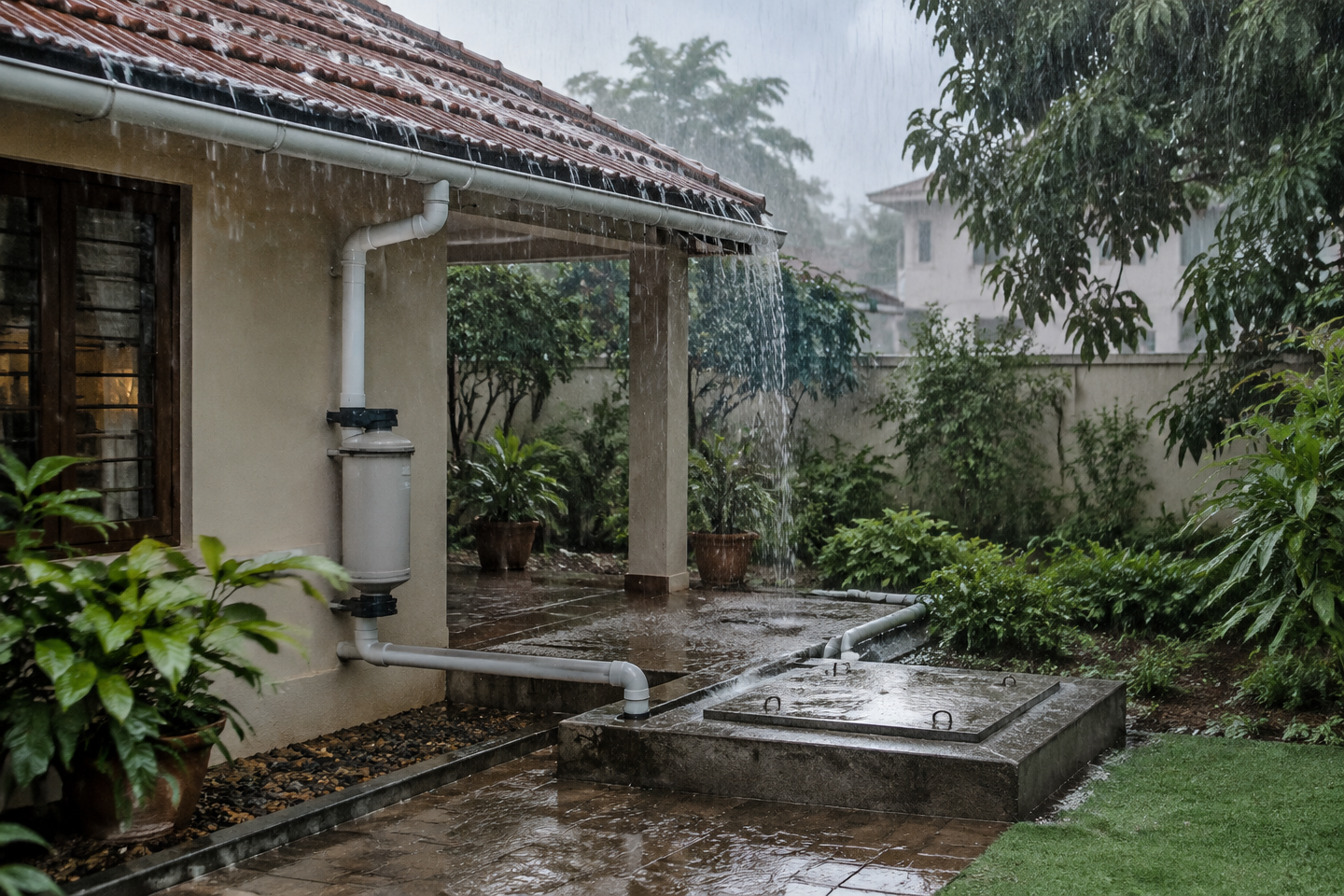
Bangalore depends on borewells and Cauvery water, and every monsoon much of the rain that falls on our roofs simply flows into the storm drain. Rainwater harvesting (RWH) captures that water — either storing it for use or sending it back into the ground to recharge the aquifer your borewell draws from. It is also a legal requirement for most new homes in the city. This guide explains the main system options, what drives the cost, and the approvals involved.
Why Bangalore homes need it
- It is mandatory for most new buildings. The Bangalore Water Supply and Sewerage Board (BWSSB) requires rainwater harvesting for new buildings on sites of 1,200 sq ft (30×40) and above as a condition for water and sanitary connections. Rules are amended from time to time, so verify the current requirement for your site size with BWSSB or your plan-sanctioning authority.
- It protects your borewell. Recharge structures put monsoon water back into the ground, which helps sustain borewell yield through the dry months.
- It reduces tanker dependence. Stored rainwater can serve flushing, gardening, washing and — with proper treatment — more uses, cutting tanker and municipal water bills.
- It reduces flooding around your plot. Directing roof water into a planned structure keeps your compound and neighbours drier.
System options for independent houses
| System | What it does | Best suited for | Points to note |
|---|---|---|---|
| Rooftop collection into a storage sump | Roof water passes through gutters, a first-flush diverter and a filter into an underground or overhead tank for reuse | Homes that want to use rainwater directly and reduce water bills | Needs storage space, a filter and periodic cleaning; water quality depends on roof hygiene |
| Recharge pit / recharge well | Filtered roof or surface water is led into a pit filled with filter media (or an abandoned open well/borewell) to recharge groundwater | Homes with a working borewell or in areas with falling water tables | Needs suitable soil percolation; sizing depends on roof area and rainfall |
| Percolation trench around the plot | A shallow trench with filter media along the compound that lets surface runoff soak in | Larger plots, corner sites, homes with gardens | Simple and low cost, but handles surface water rather than clean roof water |
| Combination system | Roof water first fills a storage sump; overflow goes to a recharge pit | Most independent houses in Bangalore | Gives both direct use and groundwater recharge; the approach we most often recommend |
Every system starts at the same place: clean gutters, downpipes sized for monsoon intensity, a first-flush arrangement that discards the initial dirty runoff, and a filter before water enters storage or the ground.
What drives the cost
We avoid quoting a single figure because the cost genuinely varies with the site. The main factors are:
- Roof area and number of downpipes — more collection points mean more piping and filtration.
- Storage vs recharge — a storage sump or tank costs more than a recharge pit of similar capacity, but gives you usable water.
- New construction vs retrofit — planning RWH during construction is significantly cheaper and cleaner than cutting into a finished house. If you are building now, this is the moment to include it.
- Filter type — from simple gravel-sand filters to branded mechanical filters with first-flush valves.
- Soil and depth — recharge structures in hard soil or rock cost more to excavate.
- Plumbing integration — connecting stored rainwater to flushing or garden lines adds plumbing work.
As a broad indication, a basic recharge-pit setup for a small house sits at the lower end of home-improvement budgets, while a full storage-plus-recharge system with plumbing integration costs more. Get a site-specific quote rather than relying on generic online figures.
Approvals and compliance
- Plan sanction and BWSSB connection: for new buildings on 30×40 and larger sites, the RWH provision is checked as part of the water and sanitary connection process. Your sanctioned plan should show the RWH structure.
- Occupancy-related checks: authorities can verify the RWH provision before issuing connections, so an RWH structure shown on paper but not built can delay your connection.
- Existing homes: BWSSB has at times required older properties above certain sizes to add RWH, with penalties in the water bill for non-compliance. Check the current position for your property.
- Apartment complexes: the requirement applies at the building level and is usually handled by the builder or association.
Requirements change with government and BWSSB notifications, so confirm the rules that apply to your site before finalising designs.
Maintenance: the part most homes skip
A rainwater harvesting system fails quietly. Keep it working with simple habits:
- Clean gutters and roof before the monsoon.
- Clean or replace filter media at least once a year, ideally twice.
- Check the first-flush diverter works and is not bypassed.
- Desilt the recharge pit or sump every few years.
- After heavy storms, inspect for blockages and overflow.
How Kumud Innovator can help
Rainwater harvesting is one of the services we provide for homes across Bangalore, both as part of new house construction and as an addition to existing homes. Because we handle the full scope — gutters and downpipes, filtration, sumps, recharge structures and the plumbing integration — the system is designed to suit your roof, soil and water needs rather than installed as an afterthought. If you are planning a new home, we include the RWH provision in the design so your approvals and connections go smoothly.
Talk to our team about rainwater harvesting for your home, or see our rainwater harvesting service for more detail.
This article is general information for homeowners in Bangalore and is not legal advice. Approval requirements change with official notifications — verify the current rules with BWSSB or your plan-sanctioning authority.